
Two Very Different Answers to the Same Question
When homeowners in Temecula or Murrieta ask us "should I go mini-split or central AC?", the honest answer starts with a question of our own: what problem are you actually trying to solve? Both technologies cool homes efficiently — but they're optimized for very different situations. Getting the wrong one wastes thousands of dollars.
Central AC in 60 Seconds
A single outdoor condenser paired with an indoor air handler pushes conditioned air through ductwork to every room in the house. Great when: you have existing ductwork in good condition, you want whole-home cooling from a single thermostat, and your home layout is relatively conventional.
Ductless Mini-Splits in 60 Seconds
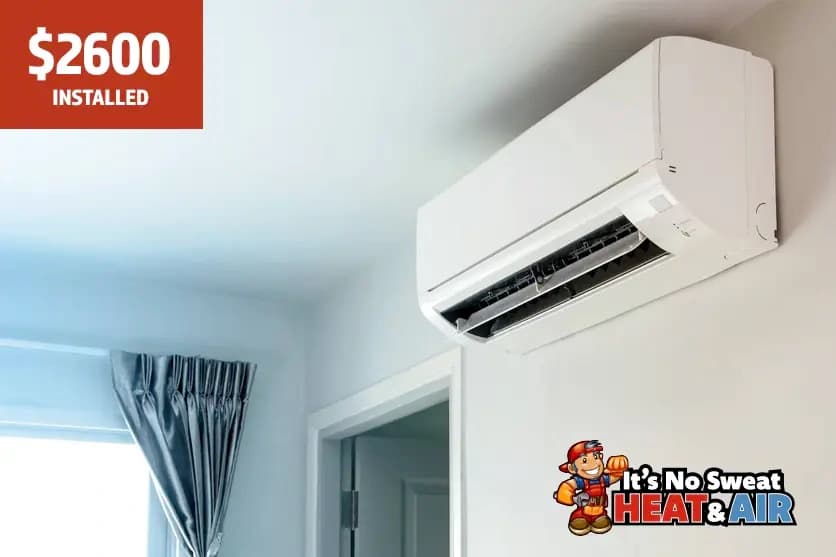
Individual indoor "heads" mount on walls or ceilings, each connected by refrigerant lines to a small outdoor unit. Each head can be controlled independently. Great when: you don't have ductwork, you're adding conditioning to a specific area (garage conversion, addition, sunroom), or you want zone-by-zone temperature control.
Efficiency Head-to-Head
Modern ductless mini-splits routinely hit SEER2 ratings of 22–30, significantly outperforming most central systems in raw efficiency. But — and this is critical — that efficiency edge shrinks or disappears if you're using a mini-split for whole-home cooling, because you're running multiple compressors. The ENERGY STAR ductless heating and cooling guide outlines where the technology genuinely shines.
Cost Comparison
Ballpark installed pricing for a 2,000 sq ft Inland Empire home:
- Central AC (replacing existing system, ducts in place): $8,000–$14,000
- Central AC (new install, no existing ducts): $15,000–$25,000
- Ductless multi-zone mini-split (4-zone whole home): $16,000–$24,000
- Single-zone mini-split (one room): $4,000–$7,000
When Central AC Wins
- You already have functional ductwork
- You want one thermostat for the whole house
- You prefer no visible indoor equipment
- You're on a tighter budget for whole-home replacement
- You want the simplest possible system to maintain
Our central AC installation team handles complete replacements across every Inland Empire city we serve.
When Mini-Splits Win
- No existing ductwork, or ducts in unsalvageable condition
- Additions, garage conversions, or sunrooms
- Two-story homes with major hot/cold zone problems on the second floor
- Casitas, ADUs, or detached structures
- You want per-room control (nursery cooler than the rest of the house)
- You need heating and cooling and want the efficiency of a heat pump
The Hybrid Approach
Many Inland Empire homes benefit from a hybrid: central AC for the main living areas paired with a single-zone mini-split for a problem room (upstairs master, converted garage, home office over a garage). This often costs less than upsizing central AC or going full ductless, and delivers better comfort.
Maintenance Realities
Mini-splits require regular filter cleaning at each head (every 4–6 weeks in the Inland Empire), and coils are more exposed than central systems — leading to earlier degradation without care. Central systems have fewer maintenance touch-points but concentrated failure risk. Either way, professional annual HVAC maintenance extends system life significantly. And when repairs are needed, our AC repair team works on both systems.
Get an Honest Recommendation
We install and service both technologies, so we have no incentive to steer you toward one over the other. A free in-home assessment includes a load calculation, ductwork condition review, and zoning analysis — you get a real recommendation grounded in your specific home. Request your free assessment or call (951) 331-3310 today.
About the Author
Justin Jaszewski
Co-Founder & NATE-Certified Technician
Justin is the co-founder of It's No Sweat Heat & Air and a NATE-certified HVAC technician with over 25 years of hands-on experience across Moreno Valley and the Inland Empire. He leads the company's technical standards, trains every technician on the team, and personally inspects complex installations. Justin holds California HVAC license #1058772 and specializes in residential system design, load calculations, and energy-efficiency upgrades.